In the bull’s eye: An influential pro-Israel group targets Malaysia
By James M.
Dorsey
Cutting through the fog of information wars that
thrive on mis-and dis-information is crucial world wracked by brutal wars,
unimaginable humanitarian crises, and increasing authoritarianism.
For the past 15 years, The Turbulent World with James M.
Dorsey seeks to empower readers, listeners, and viewers to form informed
opinions of their own by providing independent, hard-hitting reporting and
analysis of the politics of the Middle East and the Muslim world.
Newsletters and podcasts like The Turbulent World fill an
important gap in an era in which many news organisations have reduced or
abandoned coverage of international and pressure on reporters and analysts who
honour the principles of fairness and accuracy is on the rise.
That makes it more crucial than ever to ensure the
survival of newsletters such as The Turbulent World, which rely exclusively on
the support of their readers.
If you share these
values and can afford it please click here.
To participate in a poll, listen to the podcast, or watch
the video, click here.
Malaysia,
unlike other perceived Muslim Brotherhood supporters such as Qatar and
Turkey, has remained, by and large, in the shadows of the Middle East's
information wars, despite the country’s public support for Hamas.
That may change
if a recent report by the Philadelphia-based far-right,
pro-Israel Middle East Forum is anything to go by.
The report,
in support of the Trump administration's assault on academic freedoms,
particularly in Middle East and Islam studies, alleges that a Qatar, Turkey,
and Malaysia-backed Islamist network controls a prominent inter-faith institute
at Georgetown University.

The Middle
East Forum is not just another activist think tank. It maintains close ties to officials
in the Trump administration and plays a prominent role in identifying and
targeting pro-Palestinian activists, including those that the administration has
detained and wants to deport.
Among those
targeted is Badar Suri Khan, a 41-year-old Indian postdoctoral fellow at
Georgetown.
Mr. Suri was
detained in March for two months by US authorities and released on bail in May
pending deportation proceedings on charges of "spreading Hamas propaganda
and promoting anti-Semitism on social media" after the Forum and the
Committee for Accuracy in Middle East Reporting and Analysis (CAMERA) targeted
him and his wife, an American citizen.
Mr. Suri’s
father-in-law, Ahmed Yousef, was an advisor to Ismail Haniyeh, a senior Hamas
official killed by Israel while on an official visit to Tehran a year ago.

The Middle
East Forum report featuring a picture of assassinated Hamas leader Ismail
Haniyeh Georgetown Fellow Badar Khan Suri
“Over the
past three decades, malign foreign influence actors from Qatar, Turkey, and
Malaysia have entrenched themselves at Georgetown University, using the
institution’s campuses in Washington, DC and Doha as bases to propagate
Islamist ideology, train sympathetic academics and diplomats, and fundamentally
reshape Middle East and Islamic studies,” the report charged.
While
tariffs topped US Secretary of State Marco Rubio’s agenda as he landed in Kuala
Lumpur this week for four days of meetings with Association of Southeast Asian
Nations (ASEAN) leaders, he was sure to raise support for Hamas with his
Malaysian counterparts, according to well-placed sources.
A brief State Department statement announcing Mr. Rubio’s first trip to
Asia since assuming office did not mention Hamas.
The sources
said tariffs were not Mr. Rubio’s only focus. Hamas would likely figure in his
discussions with the Malaysians on combating transnational crime.

Alongside
addressing transnational crime, Mr. Rubio also expects to raise maritime safety
and security in the South China Sea during his meetings with Malaysian and
other regional leaders.
Mr. Rubio's
timing, particularly regarding transnational crime and political violence, may
be fortuitous.
Last month, Malaysian
authorities arrested 36 Bangladeshi migrant
workers accused of belonging
to an Islamic State network.
Of those
arrested, five were charged with terrorism-related offences, 15 face
deportation, and 16 remain under investigation, with the police anticipating
further arrests. Malaysian authorities suspect that as many as 150 individuals were associated with the network.
To be sure,
Hamas, unlike the Islamic State, has largely restricted its violence to Israeli
targets rather than engaging in a transnational jihad.
Even so, by
adding Malaysia to its list of Hamas-supporting culprits, the Middle East Forum
has potentially put the Southeast Asian nation in the bull's eye.
Although
long viewed as an anti-Israel force, whose leaders, at times, have not shied
away from anti-Semitism, the report puts Malaysia on par with Qatar and Turkey,
long-standing bêtes noires of Israeli, pro-Israeli, and conservative
anti-Islamist, anti-Qatar, and anti-Turkey campaigns that seek to silence
alternative voices and limit academic freedoms and freedoms of expression.
The Forum
report asserted that Malaysia had joined Turkey and Qatar in a “Sunni (Muslim)
Islamist axis” that “has played an increasingly vital role in the spread of
extremism in the West, as well as funding and supporting terrorism in the East.”

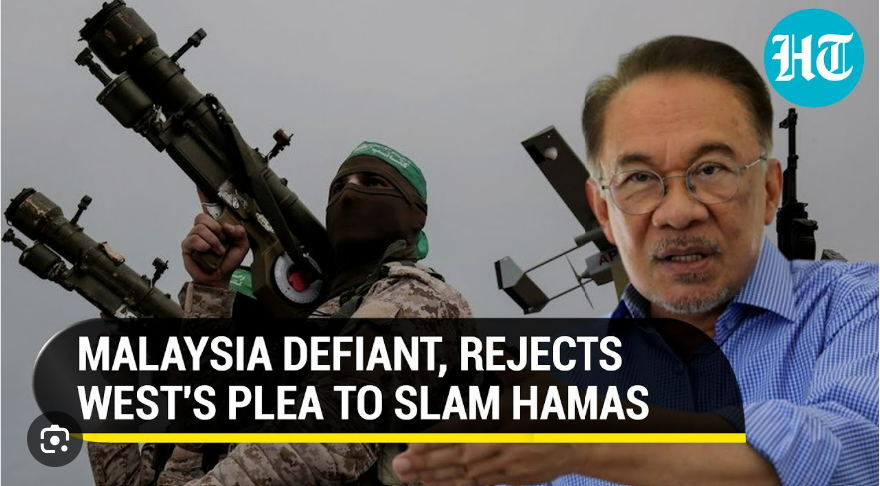
Prime
Minister Anwar Ibrahim addresses parliament
As one of a
few countries that, like Qatar and Turkey, allow Hamas to operate openly,
Malaysia is an obvious target for pro-Israel activists with influence in the
Trump administration and among Republicans.
Speaking to
parliament weeks after Hamas’ October 7, 2023, attack on Israel, Malaysian Prime
Minister Anwar Ibrahim insisted, "We, as a policy, have a relationship
with Hamas from before and this will continue."
At about the
same time, Mr. Ibrahim pledged Malaysia's “unwavering support for the
Palestinian people”
in a phone call with Mr. Haniyeh, the
assassinated Hamas official.
Two of Mr.
Ibrahim’s Cabinet members, Rural and Regional Development Minister Ahmad Zahid
Hamidi and the prime minister’s Home Affairs Minister Saifuddin Nasution Ismail,
co-founded in 2011 the Kuala Lumpur-based Palestinian Cultural Organisation
Malaysia (PCOM), popularly known as Hamas’ embassy.
The
organisation raises funds through a network of Malaysian civil society groups. It
advises potential donors knocking on its door to contact those groups.
As Mr.
Ibrahim expressed support for Hamas, authorities accused one of the
organisation’s Malaysian support groups, Aman Palestin Berhad, of money
laundering and abuse of public funds.

An Israeli
intelligence-affiliated information centre reported years earlier that Hamas
hosted social and cultural activities at the International Islamic University
Malaysia that helped the group’s military wing
recruit Palestinian students.
Israeli
Prime Minister Binyamin Netanyahu, speaking on Capitol Hill this week during
his visit to Washington, blamed declining Democratic Party support for Israel
on "a concerted effort to spread
vilifications and demonization against Israel on social media."
Mr.
Netanyahu charged, “It’s funded, it’s malignant, and we intend to fight it,
because nothing defeats lies like the truth, and we shall spread the truth for
everyone to see it. Once people are exposed to the facts, we win, hands down.”
Mr. Trump
made no mention of the Forum and other US groups that are an integral part of
Israel's uphill battle to reverse the country’s battered image because of its
conduct in the Gaza war and rejectionist Palestine-related policies.
For the
longest time, Qatar, rather than Malaysia, was the Forum's prime target,
because it hosts exiled Hamas officials at the request of the United States and
with past Israeli acquiescence and plays a central role in Israeli-Hamas
proximity talks aimed at achieving a Gaza ceasefire.

So was
Turkey, albeit to a lesser extent, because of its support for Hamas, described
by President Recep Tayyip Erdogan as a "liberation group”, the Muslim Brotherhood,
anti-Kurdish militias in northern Syria, and erstwhile jihadist groups that
control Syria since last December's toppling of President Bashar al-Assad.
The
Georgetown University report follows a recent series of Forum publications
that accused Georgetown of having “links…to hostile foreign states and a powerful domestic extremist
network that has gained influence over one of the nation’s top universities.”
One article
asserted that Qatari funding for US universities, including Georgetown,
Harvard, and Northwestern, had turned campuses into breeding grounds
for extremist ideologies by manipulating curricula and promoting a pro-Hamas narrative. The
article charged that the funding had fuelled the rise of anti-Semitism.
The
publications claimed that Qatari funding for US universities, including
Georgetown, Harvard, and Northwestern, had allowed it to manipulate curricula
and promote a pro-Hamas narrative. They charged that the funding had fuelled
the rise of anti-Semitism.

A Forum
report entitled, ‘America for Sale,’ published earlier this year, charged that
Qatar was waging an “aggressive $40 billion campaign to control US
institutions, posing a dire threat to national security… Doha's unchecked
influence extends into energy, AI, real estate, and education, undermining
America's core values.”
A Middle
East analyst with close Malaysian government ties asserted that the
Malaysia-related building blocks of the Georgetown report “are all stuff taken
out of context.”
The report
singles out Georgetown ‘s Prince Alwaleed Bin Talal Center for Muslim-Christian
Understanding (ACMCU), named after its primary donor, one of Saudi Arabia’s
most prominent businessmen who is invested in multiple American blue chips.
The centre
is part of Georgetown’s Edmund A. Walsh School of Foreign Service, a go-to institution
for students aspiring to US government careers.
Mr. Bin
Talal is known for his long-standing liberal social practices, including
advancing women’s careers in his companies, which precede Crown Prince Mohammed
bin Salman’s reforms.

“Georgetown
University’s Alwaleed Center for Muslim-Christian Understanding is ground zero
for malign influence actors from Qatar, Turkey, and Malaysia,” said Winfield
Myers, the Forum’s managing editor and director of Its Campus Watch Project.
The project
targets scores of academics at American universities, whom it views as Islamist
and/or anti-Israel.
Messrs.
Ibrahim, the Malaysian prime minister, and Mr. Suri, who is awaiting US
deportation hearings, are Alwaleed Center fellows.
The report
charged that “ACMCU…was established, developed, funded, and staffed by the
terror-tied Safa Network.”
“The Safa
Network, which controls hundreds of millions of dollars of assets …today works
to homogenise Muslim communities, theocratise education, and propagate Islamist
ideology,” the report added.
The report
went on to say that “through the steady corruption of Islamic and Middle
Eastern studies, ACMCU and Safa officials have miseducated or radicalised
generations of academics and foreign service officers who now hold positions in
top academic institutions, think tanks, international organizations, and
federal departments and agencies.”

The
controversial network, also known as the SAAR Network, borrowed the initials of
its founder, prominent Saudi Islamic finance banker, Sulaiman Abdul Aziz Al-Rajhi.
Mr. Al-Rajhi’s
name was on a list of alleged earl-day influential Saudi financiers of Al-Qaeda
at a time when the group was not yet proscribed by the United Nations, the
United States, and others.
In the wake
of the 9/11 Al-Qaeda attacks on New York and Washington, US federal agents
raided the Herndon, Virginia, premises of the SAAR Foundation, which
coordinated the network’s numerous charities, think tanks, and businesses on
suspicion of money laundering and funding of terrorism but never filed charges
against the network or the foundation.
The network
operated from the premises even after the foundation was dissolved in December
2000.
However, US
authorities indicted on various charges several people associated with the
Virginia-based International Institute of Islamic Thought (IIIT).
The Forum
report described the institute as the Safa Network’s “flagship institution and
a key partner of ACMCU” and “perhaps the most prominent Muslim Brotherhood
think tank in the world.”

Those
sentenced include Sami al-Arian, an alleged Palestinian Islamic Jihad activist.
Mr. Al-Arian was convicted under the Patriot Act and deported to Turkey in
2009. Mr. Al-Arian’s son-in-law, Jonathan A. Brown, holds a chair at the
Alwaleed Center.
Commenting
on the Forum report, Malaysian sources denied its assertion that Mr. Ibrahim
chairs the Islamic institute. The Middle East analyst with government
connections said that Mr. Ibrahim “has not been involved in IIIT for a
considerable amount of time.”
The institute’s
website identifies 84-year-old electrical engineer and Muslim activist Hisham Altalib as its president.
Malaysian
officials disregard the Forum report at their peril.
In its
Malaysia-related recommendations, the report advocates investigating Alwaleed
Center faculty who “aim to sway public opinion” in favour of Malaysia, Qatar,
and/or Turkey as foreign agents and adding the International Islamic University
Malaysia to the Defence Department’s list of “foreign institutions engaging in
problematic activity.”
Dr. James M. Dorsey is an
Adjunct Senior Fellow at Nanyang Technological University’s S. Rajaratnam
School of International Studies, and the author of the syndicated column and
podcast, The Turbulent World with James M. Dorsey.


Comments
Post a Comment